North Brother Island, the Bronx’s Abandoned Quarantine Isle
North Brother Island is a small, uninhabited island in the East River, between the mainland Bronx and Rikers Island. For decades it held Riverside Hospital, New York City’s quarantine hospital, and today it is a closed bird sanctuary overgrown with trees and ruined buildings. It is one of the best-known abandoned places in New York, but it cannot be visited by the public.
A forest now hides the quarantine hospital where Typhoid Mary spent more than two decades, and where the burning steamship General Slocum ran aground in 1904. Almost no one is allowed to land.
The history of North Brother Island
The Dutch West India Company claimed North Brother Island and its smaller neighbor, South Brother Island, in 1614, and the pair was originally named De Gesellen, “the companions”. In 1695 the British government granted both islands to James Graham, who did not develop them because the currents in the area were treacherous. North Brother was originally part of Queens County and was transferred in 1881 to New York County, in an area that later became the Bronx. A lighthouse was built there in 1869, but the island stayed uninhabited until 1885.
In the mid-1880s Riverside Hospital moved to the island from Blackwell’s Island, today’s Roosevelt Island. It had been founded in the 1850s as a smallpox hospital to isolate victims of that disease, and its mission later widened to other diseases that required quarantine, including typhoid and tuberculosis. During the 1916 polio epidemic it treated numerous patients. The oldest building dates from 1885 and the last one, the Tuberculosis Pavilion, opened in 1943; it became obsolete within the decade as vaccination spread.
The island is also tied to one of the worst disasters in the city’s history. On June 15, 1904, the steamship General Slocum caught fire on the East River, and 1,021 people died, either from the fire or from drowning, before the ship beached on the island’s shore. Another well-known name is Mary Mallon, “Typhoid Mary”. Declared a public menace in 1915, she was confined to the island for more than two decades, and after a stroke in 1932 she lived in the hospital until she died there in November 1938. Researchers estimate that she infected at least 122 people, five of whom died.
By the 1930s advances in public health had reduced the need to quarantine large numbers of people in a remote location. After World War II the island housed veterans who were students at local colleges, along with their families, and when the housing shortage eased it was abandoned again. In the 1950s a center opened to treat adolescent drug addicts and claimed to be the first to offer treatment, rehabilitation and education for young offenders. Many patients felt they were held against their will, and staff corruption and costs closed it in 1963. It is said to have inspired the Broadway play Does a Tiger Wear a Necktie?, which helped launch Al Pacino’s career.
Since the mid-1960s mayors have weighed different ideas: John Lindsay proposed selling it, Ed Koch thought of housing for the homeless, and the city also considered an extension of the Rikers Island jail. Today the island is a sanctuary for herons and other wading birds, and most of its original 25 buildings still stand in extreme disrepair, hidden by dense forest. Council member Mark Levine led a visit in 2014, and a 2016 study looked at turning it into a park with controlled access, but the cost and hazards stopped any plan. In March 2025 firefighters needed more than five hours to put out a fire in one of the buildings, where the roof collapsed.
Little-known facts about North Brother Island
- The island’s original Dutch name, De Gesellen, means “the companions”, and one source credits the navigator Adriaen Block with naming the pair.
- Mary Mallon, “Typhoid Mary”, was held on the island for more than two decades and died there in November 1938.
- The General Slocum disaster of 1904 killed 1,021 people, and the burning steamship beached on the island’s shores.
- The writer Joseph Mitchell described outings of the “Honorable John McSorley Pickle, Beefsteak, Baseball Nine, and Chowder Club” held on the island, and photos of the outings hang in McSorley’s Old Ale House.
- From the 1980s to the early 2000s the island had one of the area’s largest nesting colonies of black-crowned night herons, but by 2008 the birds had left for unknown reasons; barn swallows still nest in the buildings.
- Visitors in 2017 reported that few buildings still had a functional roof and that poison ivy was a problem everywhere.
North Brother Island on screen
The island is rarely seen because it is closed, but television crews have been allowed on it.
- What on Earth? (Science Channel) (2017) – An episode was filmed on North Brother Island, and the crew was accompanied by a journalist.
Tours near North Brother Island
Experiences in the area that you can book online with Viator:


Visiting North Brother Island: what you can and cannot do
- North Brother Island is closed to the public. It is managed by the New York City Parks Department as a wildlife sanctuary, and landing on your own is not allowed.
- Permission is occasionally given to researchers and journalists, who are always escorted by a parks staff member. Permits are issued only for compelling academic and scientific purposes.
- The buildings are in very poor condition, some are in danger of collapse, and open manholes and dense vegetation add hazards. Reports about opening the island to the public have not led to concrete steps so far.
- The sources do not name a public viewpoint, so check the current rules and look for a ferry, boat or waterfront option from authorized sources rather than trying to reach the island yourself.
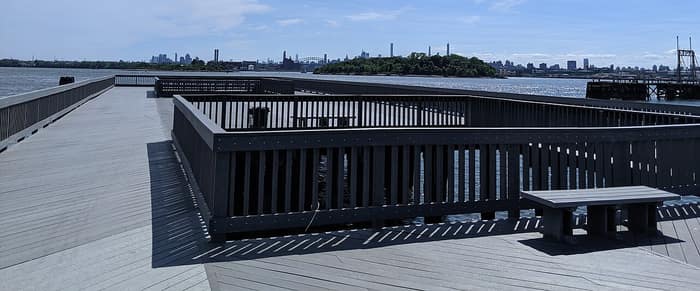
- The nearby Bronx waterfront, with places such as Barretto Point Park, is a public area where you can explore the Bronx shoreline of the East River.
Opening hours, access and conditions can change. Check before you go.
Map: where North Brother Island is
Questions
Can you visit North Brother Island?
No, not as a regular visitor. It is closed to the public and permission is given only occasionally to researchers and journalists, escorted by parks staff. Check the current rules.
Where is North Brother Island?
It is in the East River in the Bronx, between the mainland Bronx and Rikers Island. South Brother Island lies about a half-mile to the south.
Why is North Brother Island famous?
It held Riverside Hospital, where Mary Mallon, “Typhoid Mary”, was confined, and it is where the burning steamship General Slocum ran aground in 1904.
What happened to Riverside Hospital?
It moved to the island in the mid-1880s and treated diseases that required quarantine. As public health advanced, the need for it declined in the 1930s, and the island was later used for housing and a drug treatment center before being abandoned.
Who lives on North Brother Island now?
No people. The island is a sanctuary for herons and other wading birds, and barn swallows nest in the ruined buildings.
Are the buildings still standing?
Most of the original 25 buildings still stand, but in extreme disrepair, and some may collapse. A forest now hides much of the ruined hospital.
Also nearby
South Brother Island
South Brother Island · a closed East River island for herons
500 m away
Steinway Mansion
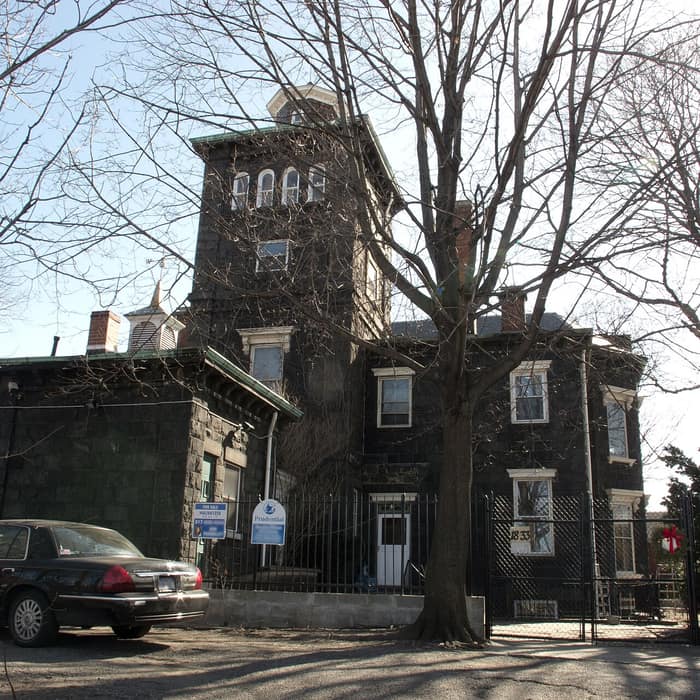
Steinway Mansion · a 19th-century villa hidden in Astoria
2.5 km away
Hell Gate Bridge
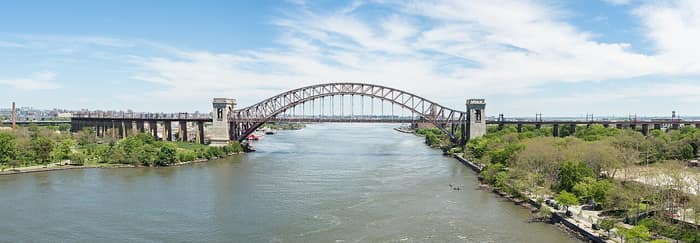
Hell Gate Bridge · a 1917 steel rail arch over the East River
3 km away
Marine Air Terminal
Marine Air Terminal · LaGuardia’s landmark flying-boat terminal
3 km away