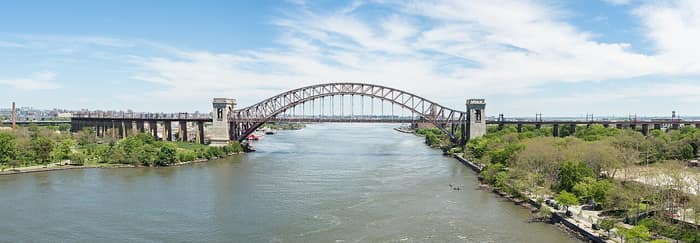
Hell Gate Bridge, the Steel Arch That Inspired Sydney
The Hell Gate Bridge is a railroad bridge that crosses the East River between Astoria, Queens, and the Bronx via Wards and Randalls Islands. Its main span is a 1,017-foot steel through arch, opened in 1917, and it was the longest steel arch in the world until 1931. It is a hidden icon of New York City engineering that most visitors only glimpse from a train window.
When the two halves of this 1,017-foot steel arch met in 1915, the gap between them was just five-sixteenths of an inch. A century later it still carries trains, yet few people ever walk beneath it.
The history of the Hell Gate Bridge
At the end of the 19th century there was no direct rail link between New England and New Jersey, nor between Long Island and the rest of the continental United States. Trains crossed the busy waters of New York on barges. The New York Connecting Railroad was formed in 1892 to build a bridge, linking the Pennsylvania Railroad with the New York, New Haven, and Hartford Railroad. A cantilever design was approved in 1900, but delays, a change of owners and fights over the franchise followed. In 1904 the Pennsylvania Railroad hired the engineer Gustav Lindenthal, who rejected the cantilever plan, partly because the approach had to curve around hospitals on Wards Island, and chose a steel arch instead.
Lindenthal worked with the architect Henry Hornbostel, and the young engineers Othmar Ammann and David B. Steinman assisted. The Municipal Art Commission first rejected the plans as “not artistic”, and the revised design was approved in 1911. The foundations were hard work: on Wards Island, 21 caissons had to be sunk through sand, gravel and boulders to rock more than a hundred feet down, a job that took seven months. The arch itself could not be built on temporary supports over the navigable strait, so crews cantilevered the two halves outward from the shores, anchored by huge backstays behind the stone towers.
Around a thousand workers and 40 engineers started on the steel in November 1914, many of them Mohawk ironworkers. The two halves were joined on October 1, 1915, with a gap of just five-sixteenths of an inch, a precision credited to the detailed drawings and surveying tools. About 400,000 rivets were then driven into the span. The bridge’s first train ran at a dedication ceremony on March 9, 1917, and intercity passenger trains began on April 1. It was the first East River bridge built by a private company, and it let passengers travel the Northeast Corridor without changing to a ferry.
Traffic never matched the early hopes. Only four passenger trains a day crossed in 1918, and the bridge was a target of concern in wartime: a live bomb was disarmed under it in 1940, and Operation Pastorius, a Nazi sabotage plan, was thwarted in 1942. Through the middle of the century the owners’ finances faded and the structure fell into disrepair. Amtrak took over the bridge by 1975. Debris fell from the approach viaducts in the 1970s and 1980s, and in 1991 Congress allocated money to renovate the bridge. It was repainted in 1992–96 in a deep red known as “Hell Gate Red”, although the paint began to fade before the work ended.
Today two tracks serve Amtrak’s Northeast Corridor and one serves freight. The bridge celebrated its centennial in 2017. In the 2020s the Metropolitan Transportation Authority began upgrading the line for Metro-North’s New Haven Line trains, under the Penn Station Access project.
Little-known facts about the Hell Gate Bridge
- The bridge’s design inspired the Sydney Harbour Bridge.
- It was the longest steel arch in the world until the Bayonne Bridge opened in 1931.
- The bridge was originally called the New York Connecting Railroad Bridge.
- To keep patients and inmates of the institutions on Wards and Randalls Islands from climbing the supports, the plans for the approach piers were changed from steel lattice to smooth concrete, according to the Spanish Wikipedia.
- Lindenthal added decorative girders between the top of the arch and the stone towers, because he feared the public would think the towers were not part of the structure.
- In 2005 Discover magazine estimated that, if humans vanished, this bridge could last for at least a thousand years, while most others would collapse in about 300.
Tours near Hell Gate Bridge
Experiences in the area that you can book online with Viator:


Seeing the Hell Gate Bridge
- The Hell Gate Bridge is a working railroad bridge owned by Amtrak. It has no road or pedestrian deck, so you cannot walk or drive across it, and access to the tracks is not allowed.
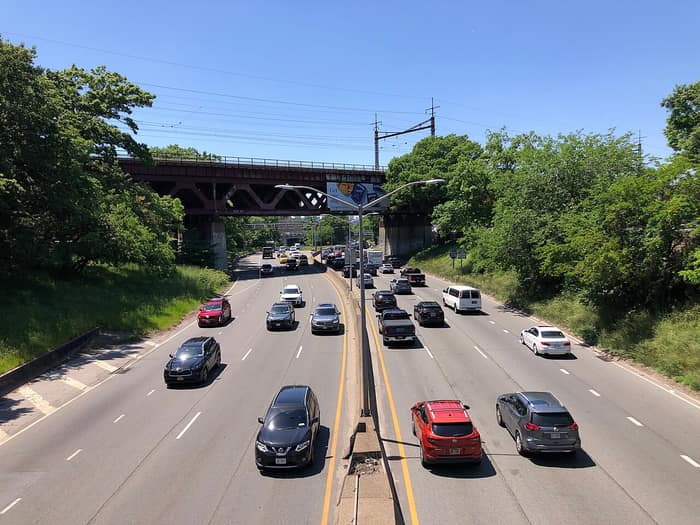
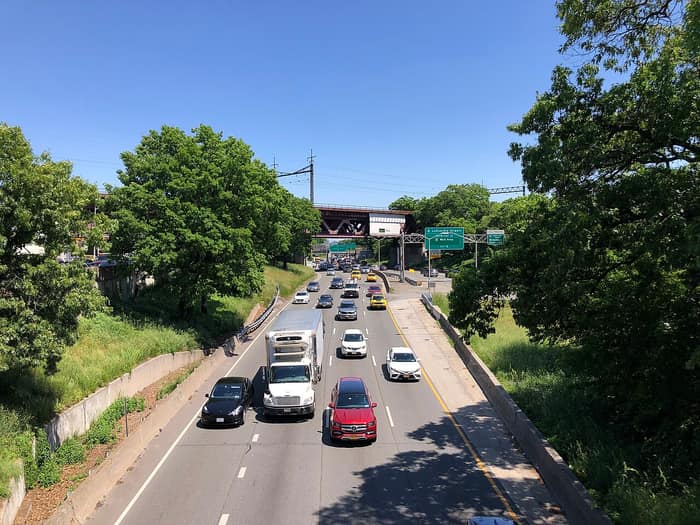
- You can see the arch from the ground in Astoria, Queens, where the long approach viaduct runs, and the Robert F. Kennedy Bridge runs close to it. Murals have been painted beneath the Queens approach by local residents and students.
- Riding an Amtrak train across the span is the best way to cross it. Writers have called the view from the bridge a reward for enduring a crowded Penn Station.
- The two Amtrak tracks are part of the Northeast Corridor, so check the current train schedules and routes if you want to ride across.
- Debris from the viaducts has been a local concern, so stay on public streets and do not try to climb on the structure.
Opening hours, access and conditions can change. Check before you go.
Map: where Hell Gate Bridge is
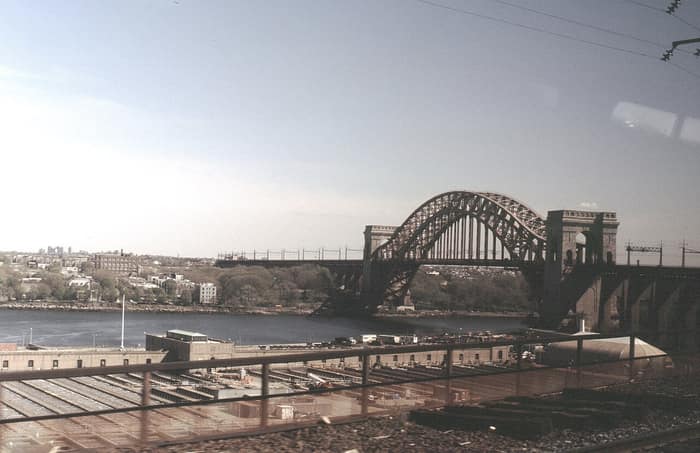
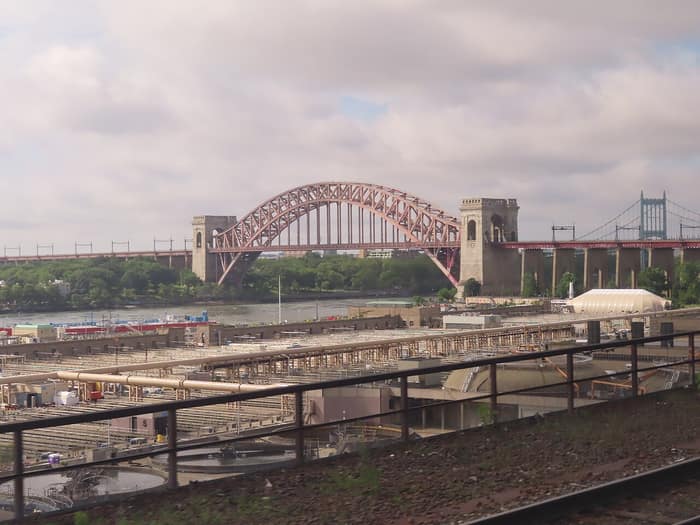
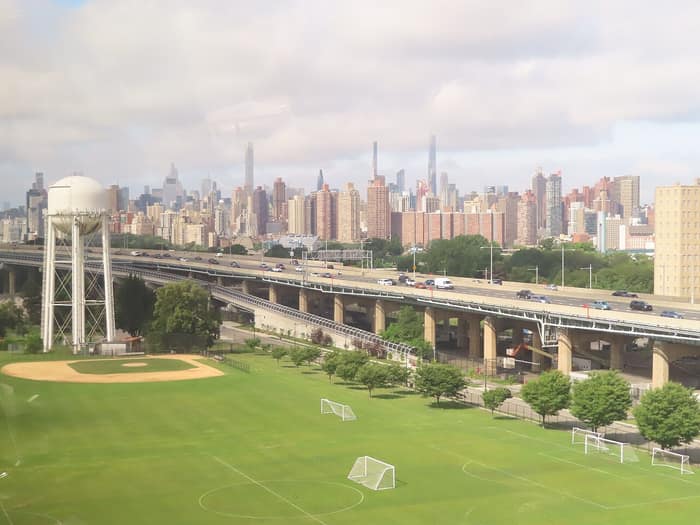
Photos of Hell Gate Bridge
Questions
What is the Hell Gate Bridge?
It is a steel arch railroad bridge over the East River that connects Astoria, Queens, with the Bronx via Wards and Randalls Islands. It opened in 1917 and carries Amtrak and freight trains.
Can you walk across the Hell Gate Bridge?
No. It was built only for trains and has no pedestrian or road deck. Look at it from public streets in Astoria or ride an Amtrak train across it.
Why is it called the Hell Gate Bridge?
It crosses Hell Gate, a strait of the East River that separates Wards Island from Queens. The bridge’s original name was the New York Connecting Railroad Bridge.
Who designed the Hell Gate Bridge?
The chief engineer was Gustav Lindenthal, assisted by Othmar Ammann and David B. Steinman, with Henry Hornbostel as the architect.
How long is the Hell Gate Bridge?
The main steel arch spans 1,017 feet. Including its approach viaducts and spans over smaller waterways, the whole bridge is roughly three miles long, though sources give slightly different totals.
Is the Hell Gate Bridge red?
Yes. It was repainted in the 1990s in a deep red known as Hell Gate Red, although the color began to fade even before the job was complete.
Also nearby
Mill Rock
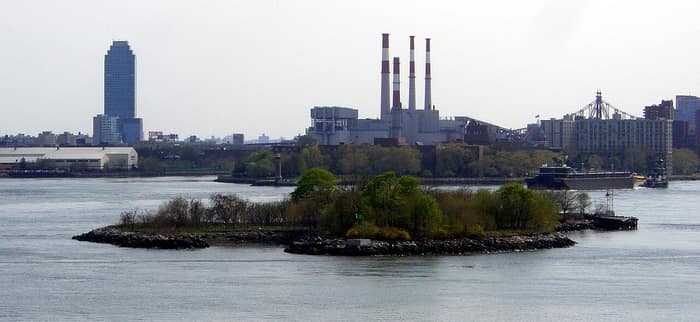
Mill Rock · a tiny island joined by a huge blast
1.5 km away
Blackwell Island Light
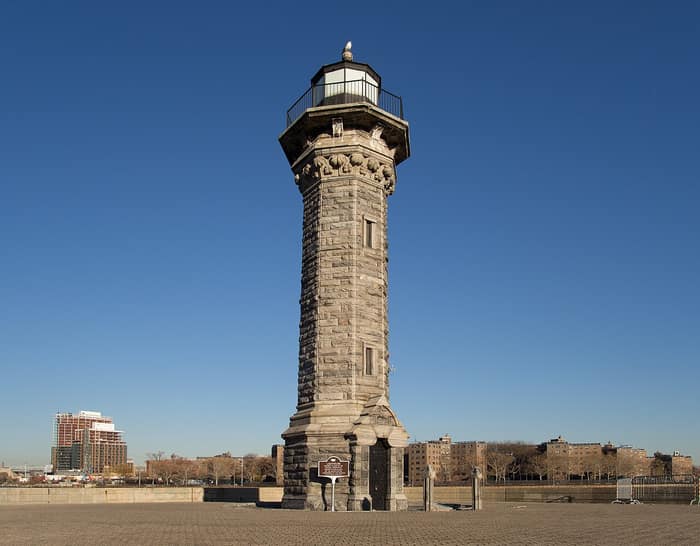
Blackwell Island Light · a Gothic stone beacon in the East River
2 km away
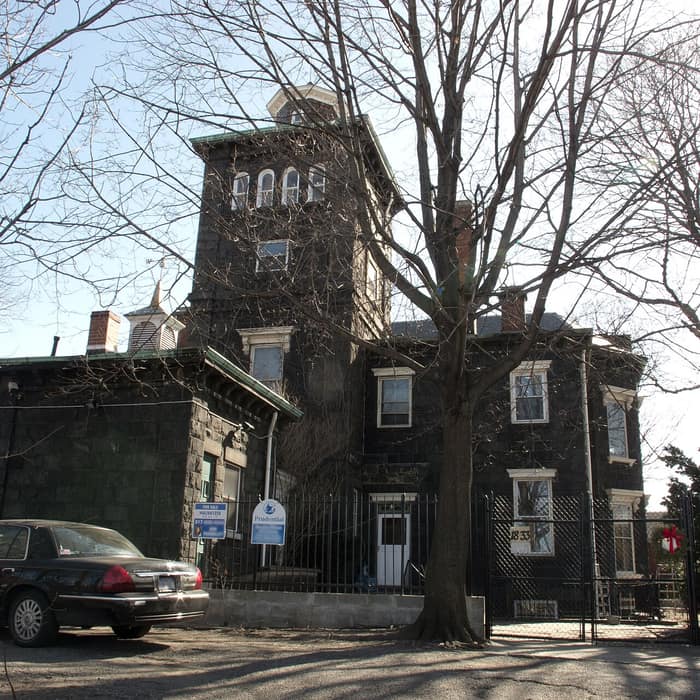
Steinway Mansion
Steinway Mansion · a 19th-century villa hidden in Astoria
2 km away
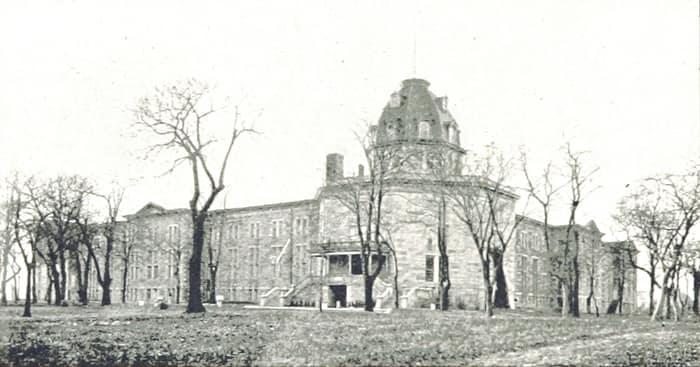
The Octagon
The Octagon · last remnant of a historic asylum, on Roosevelt Island
2.5 km away