
North River Tunnels, the Century-Old Rail Tubes Under the Hudson
The North River Tunnels are a pair of rail tubes that carry Amtrak and NJ Transit trains under the Hudson River between North Bergen, New Jersey, and Penn Station in Manhattan. Built by the Pennsylvania Railroad between 1904 and 1908, they opened in 1910 and are still in daily use. You cannot walk through them, but you can ride them, and a new pair of tunnels is planned alongside the old ones.
Two tubes dug through river mud as soft as toothpaste have carried trains from New Jersey to Midtown Manhattan since 1910. In 2012 Hurricane Sandy flooded both of them for the first time.
The history of the North River Tunnels, from ferry to tunnel
In the late 19th century the Pennsylvania Railroad (PRR) reached Jersey City but not Manhattan itself. Passengers had to cross the Hudson by ferry, which put the company at a disadvantage against the New York Central, whose trains already ran into Manhattan from the north. After an attempt to build a bridge over the Hudson failed, the PRR and the Long Island Rail Road drew up plans in 1892 for the New York Tunnel Extension, a package of tunnels and a large new terminal in Midtown. In December 1901 the plan changed from a bridge to tunnels, with the railroad arguing that a tunnel would cost about a third as much. The city’s Board of Aldermen approved the project in December 1902 by a vote of 41 to 36.
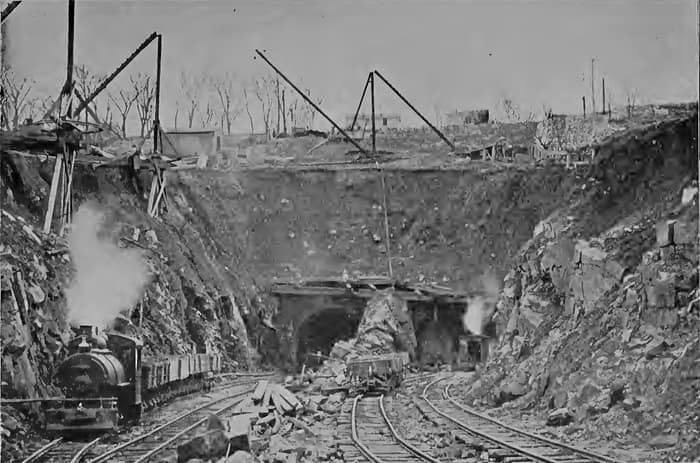
Chief Engineer Charles M. Jacobs led the design team, and the contract for the tunnels went to the O’Rourke Engineering Construction Company in 1904. The plan first called for three tubes but was later cut to two. Work began with two shafts, one just east of Eleventh Avenue in Manhattan and a larger one in Weehawken, New Jersey, finished in September 1904 and 76 feet deep. From there the tunnels were driven in three sections, with shields advancing toward each other from Manhattan, from Weehawken and from the Bergen portals on the far side of the Palisades.
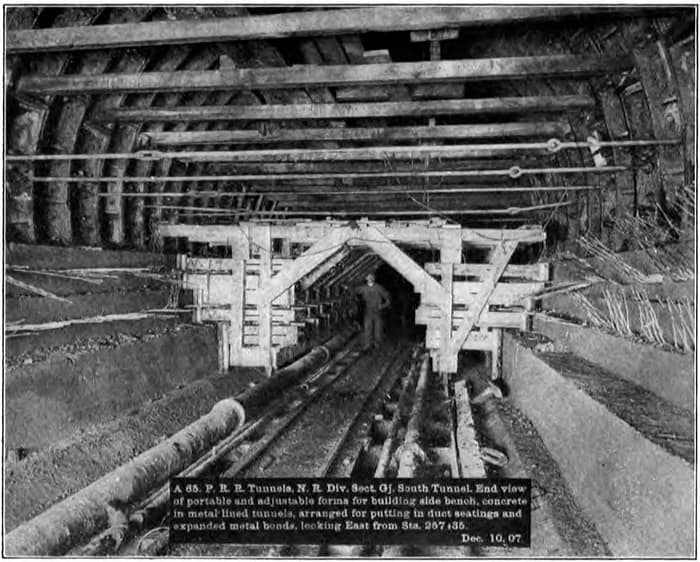
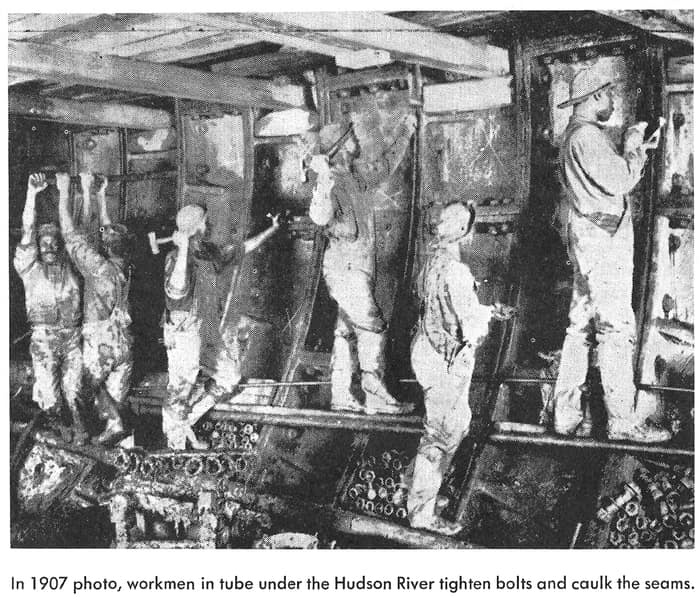
Under the river the crews found that the bed was soft mud for a great depth, so they worked under compressed air with 194-ton shields. The mud was so soft that the shields could be pushed forward without removing any ground. The tubes were lined with cast-iron rings, each 2.5 feet wide and weighing 22 tons, bolted together and covered with 22 inches of concrete. The two ends of the northern tube met in September 1906, and at that moment it was the longest underwater tunnel in the world. The Bergen Hill tunnels through the Palisades were finished in April 1908.
The tunnels opened on November 27, 1910, together with Pennsylvania Station. Until then PRR trains had stopped at Exchange Place in Jersey City, so the new line made the railroad the only one with direct access to New York City from the south. The Pennsylvania Railroad later merged into Penn Central, and Amtrak took control of the tunnels in 1976, with NJ Transit running its trains through them under contract. In 1969 a tower at 450 West 33rd Street, now called Five Manhattan West, was built above the east portals.
As traffic grew, the tubes reached their limit. They allow at most 24 trains an hour in each direction and have run near capacity at peak times since 2003. NJ Transit’s weekday trains through them rose from 147 in 1976 to 438 in 2010. In October 2012 Hurricane Sandy flooded both tubes for the first time in their history, damaging wires, electrical systems and drainage, and breakdowns became more frequent. In 2014 Amtrak said one or both tubes would have to close within about twenty years. In May 2021 federal officials approved two new tunnels, called the Gateway tunnels, scheduled to open in 2035, with the old ones to be rehabilitated by 2038.
Little-known facts about the North River Tunnels
- The two big shields that bored under the river each weighed 194 tons, and they met about 3,000 feet from the Weehawken and Manhattan portals.
- The river mud was so soft that the shield was pushed forward without taking any ground, though crews found it easier to steer when some mud was let in through holes at the front.
- When the two ends of the northern tube met in September 1906, it was the longest underwater tunnel in the world.
- The Weehawken Shaft, 76 feet deep, was dug in 1903–1904. Sources say it is unclear when its top was covered; the tracks may have stayed open to the sky until overhead wires were added around 1932.
- The two tubes run about 37 feet apart, with cross-passages every 300 feet. At the Manhattan end they fan out into 21 tracks serving Penn Station.
- Cell phone service from Verizon Wireless was added to the tunnels in 2001.
Tours near North River Tunnels
Experiences in the area that you can book online with Viator:


Seeing the North River Tunnels: what you can and cannot do
- The tunnels are active railway infrastructure and are closed to the public. Entering the tubes or the railroad’s property without authorization is not allowed.
- The simplest way to experience them is as a passenger on an Amtrak or NJ Transit train between New Jersey and Penn Station. The crossing itself happens underground.
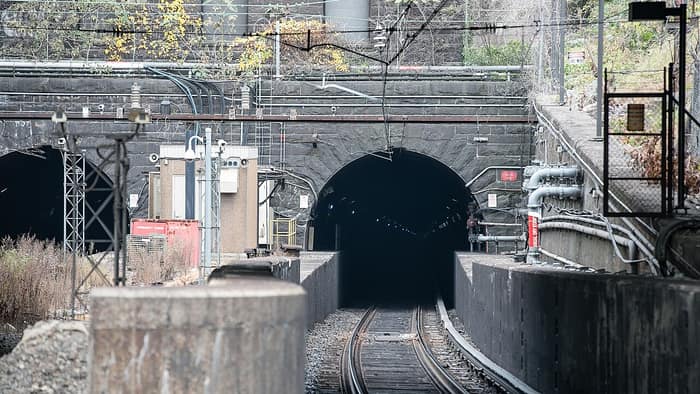
- The east portals are at the east edge of Tenth Avenue at 32nd Street, and the west portals are at the western edge of the Palisades in North Bergen. Both are railroad property, so view them only from public areas, if at all.
- The area around Penn Station and the far west side of Midtown is good for a walk; the archive photos of the tunnel’s construction help picture what lies underground.
- Check the current train service and any construction notices with Amtrak and NJ Transit before you travel.
Opening hours, access and conditions can change. Check before you go.
Map: where North River Tunnels is
Photos of North River Tunnels

Questions
What are the North River Tunnels?
They are a pair of rail tunnels under the Hudson River that connect North Bergen, New Jersey, with Penn Station in Manhattan. Amtrak and NJ Transit trains use them every day.
When were the North River Tunnels built?
They were built between 1904 and 1908 by the Pennsylvania Railroad and opened to service on November 27, 1910, together with Penn Station.
Can you visit the North River Tunnels?
Not on foot. They are active railway tunnels, so the only way to pass through is as a train passenger. Do not try to enter the portals or tracks.
Why are the tunnels in the news?
They are more than a century old and were flooded by Hurricane Sandy in 2012. A plan to build two new tunnels and then rehabilitate the old ones was approved in 2021.
Why are they called the North River Tunnels?
“North River” is the traditional name for the lower Hudson River as it flows past Manhattan. The tunnels run beneath it.
Where are the portals of the North River Tunnels?
The east portals are at Tenth Avenue and 32nd Street in Manhattan, and the west portals are in North Bergen, New Jersey, near the end of Route 3.
Also nearby

John J. Harvey
John J. Harvey · the 1931 fireboat that answered the call on 9/11
950 m away

Westbeth Artists Community
Westbeth · former Bell Labs turned artists’ housing
2.5 km away
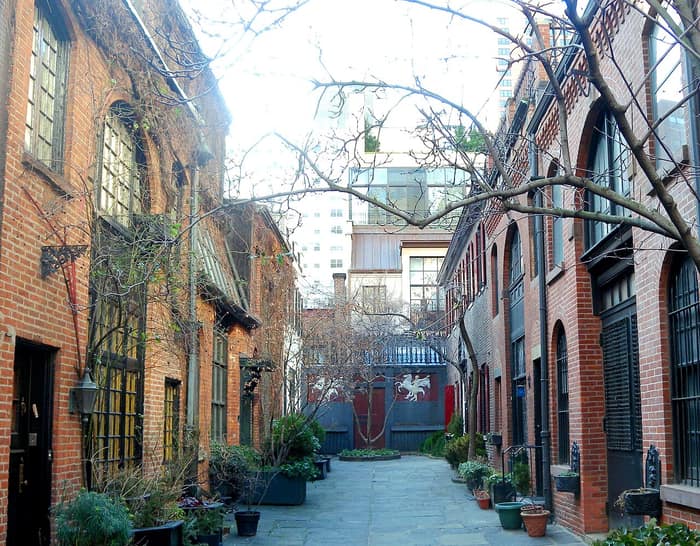
Sniffen Court Historic District
Sniffen Court · a tiny 1860s carriage-house mews in Manhattan
3 km away

St. Mark’s Church in-the-Bowery
St. Mark’s Church · Peter Stuyvesant’s vault and poets’ stage
4 km away