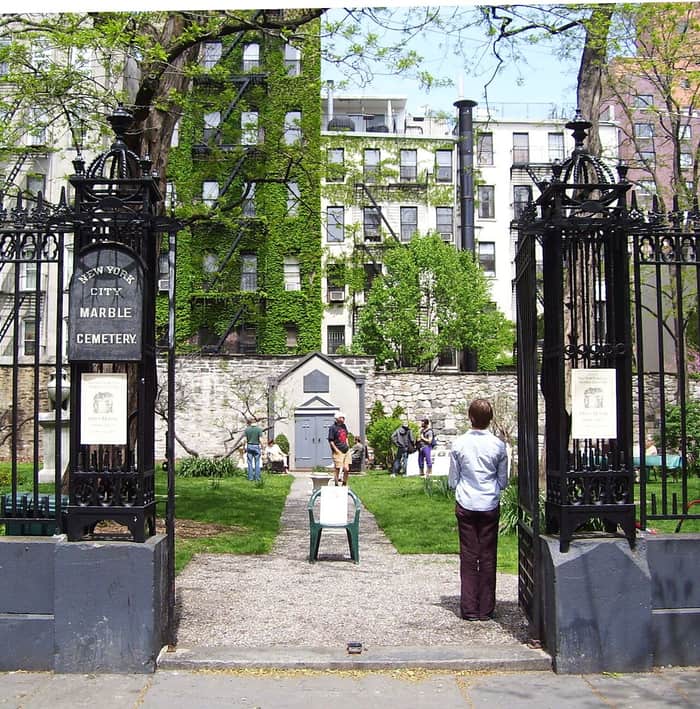
New York City Marble Cemetery, the East Village’s Secret Burial Vaults
The New York City Marble Cemetery is a historic cemetery founded in 1831, hidden at 52–74 East 2nd Street between First and Second Avenues in the East Village in Manhattan. It is made of underground vaults of Tuckahoe marble rather than ordinary graves. It is a quiet, little-known corner of the city, but it is usually closed to the public.
Behind a wall on East 2nd Street lie 258 underground burial vaults built of marble. Former presidents once rested here, and the gates open to visitors only on a few days each year.
The history of the New York City Marble Cemetery
In 1830 recent outbreaks of yellow fever had made New Yorkers afraid of burying their dead in coffins only a few feet below the surface, and public health legislation had outlawed earthen burials. The nearby New York Marble Cemetery, founded a year earlier, answered the problem by building and selling underground burial vaults of marble. In 1831 five partners, Evert Bancker, Henry Booraem, Thomas Addis Emmett, Garret Storm and Samuel Whittemore, organized a similar venture one block to the east.
They bought land from Samuel Cowdrey, an owner of a vault in the earlier cemetery, and hired Perkins Nichols, who had built the first vaults, to construct this new set. The first vaults were ready by the summer of 1831, and the cemetery was incorporated on April 26, 1832. It went on buying land on both sides of the original plot until 1835, when it reached its present size. The result was the city’s second non-sectarian burial place, a ground open to people of any faith.
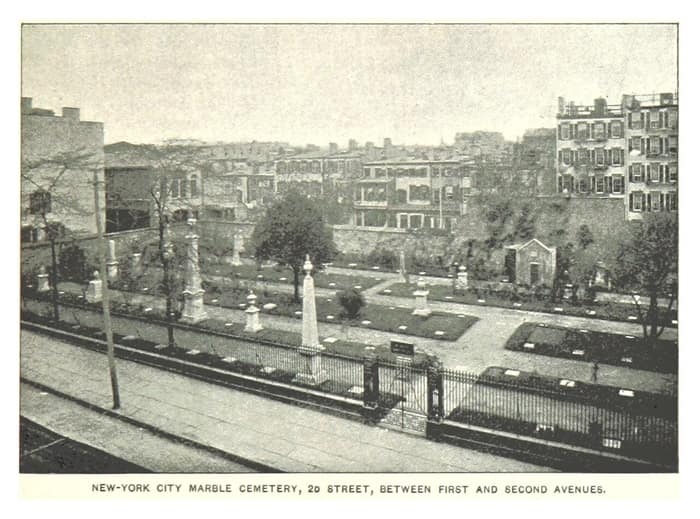
Unlike the earlier cemetery, where no markers showed where the vaults lay and their positions were recorded on a tablet in the surrounding wall, this one marked each vault with a marble marker or a monument of the owner’s choice. At the time it was considered a fashionable place to be buried. In all, the cemetery has 258 underground vaults built of Tuckahoe marble.
Among the people buried here are Stephen Allen, mayor of New York City, Isaac Varian, also a mayor, Marinus Willett, a hero of the Revolutionary War, and James Lenox, a co-founder of the New York Public Library. The financier Moses Taylor, the archaeologist John Lloyd Stephens, and James Henry Roosevelt, founder of Roosevelt Hospital, also lie here. Remains from the churchyard of the South Dutch Church were moved here, including those of the Kip family, for whom Kips Bay is named. Two famous burials were later moved elsewhere: the president James Monroe went to Richmond in 1858, and the engineer John Ericsson, designer of the USS Monitor, to Sweden in 1890. Both this cemetery and its neighbor were designated New York City landmarks in 1969 and were added to the National Register of Historic Places in 1980.
Little-known facts about the New York City Marble Cemetery
- The cemetery should not be confused with the New York Marble Cemetery one block west, which is older, founded a year earlier, and has a similar design.
- Its 258 vaults are built of Tuckahoe marble, a stone quarried in Westchester County near New York.
- President James Monroe was buried here before his remains were moved to Hollywood Cemetery in Richmond, Virginia, in 1858.
- John Ericsson, the designer of the ironclad USS Monitor, was also buried here, and his remains were taken to Sweden in 1890.
- Cemetery tradition says that the bones of the Dutch ministers, said to be the first European men buried on Manhattan island, were moved to the “Ministers’ Vault.”
- A merchant buried here is recorded with the memorable name Preserved Fish.
Tours near New York City Marble Cemetery
Experiences in the area that you can book online with Viator:


Visiting the New York City Marble Cemetery
- According to the cemetery’s own website, it is open to the public only twice a year: on a Sunday in spring and on a weekend in the fall. Dates change, so check the official site before you plan a trip.
- On the rest of the year the gate stays closed. Do not try to enter, but you can look at the entrance and wall from East 2nd Street.
- The cemetery sits in the East Village, close to the Merchant’s House Museum and the New York Marble Cemetery one block west, which makes a short walk around the neighborhood easy.
- Treat it as a burial ground: walk quietly and avoid stepping on the vault markers.
Opening hours, access and conditions can change. Check before you go.
Map: where New York City Marble Cemetery is
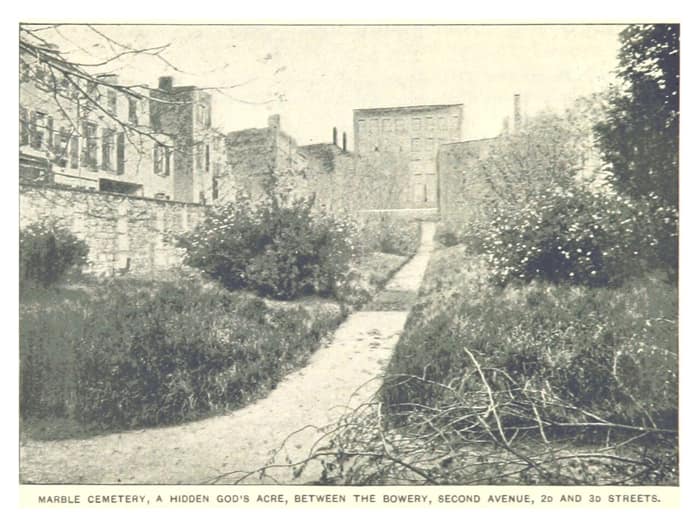
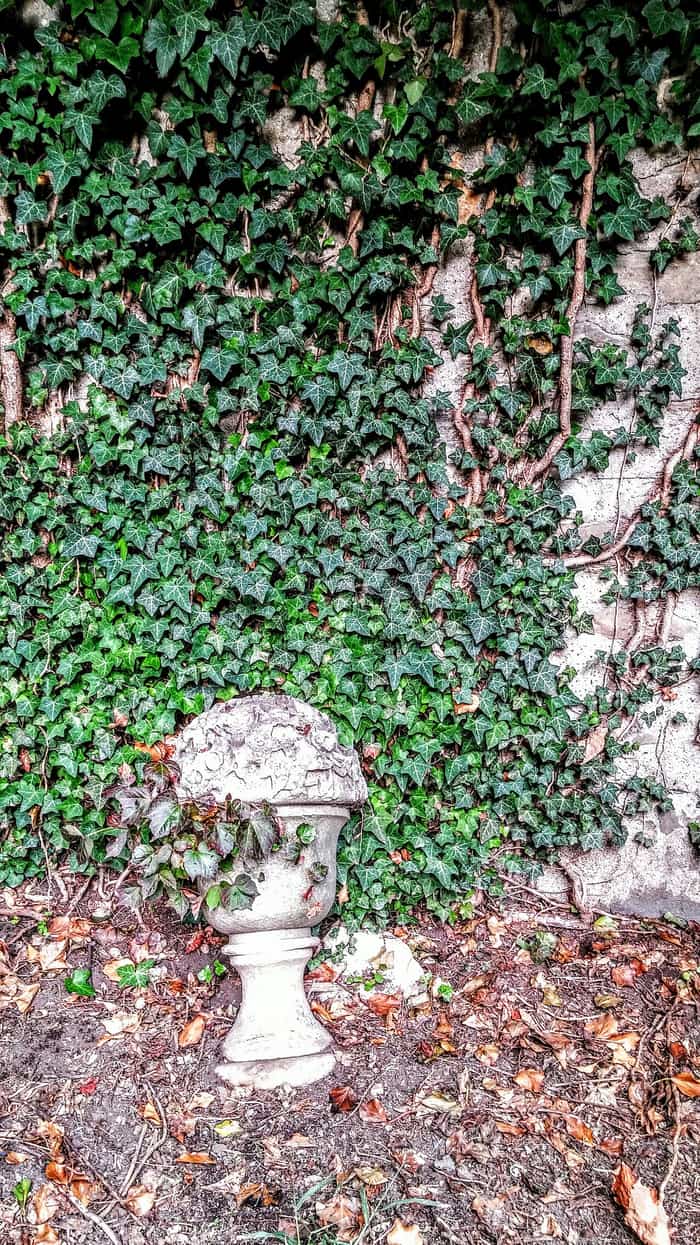
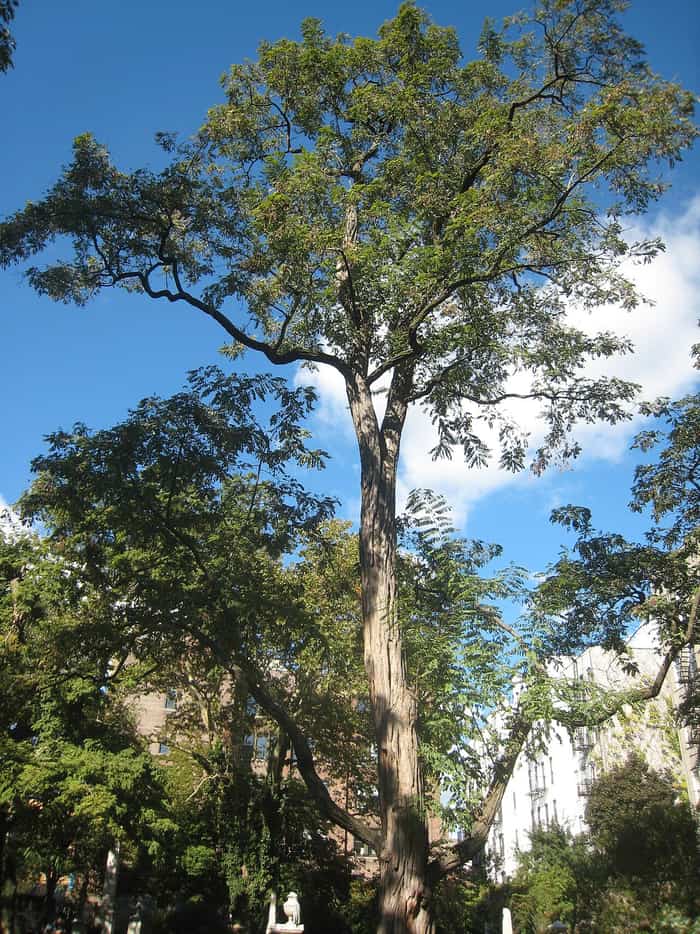
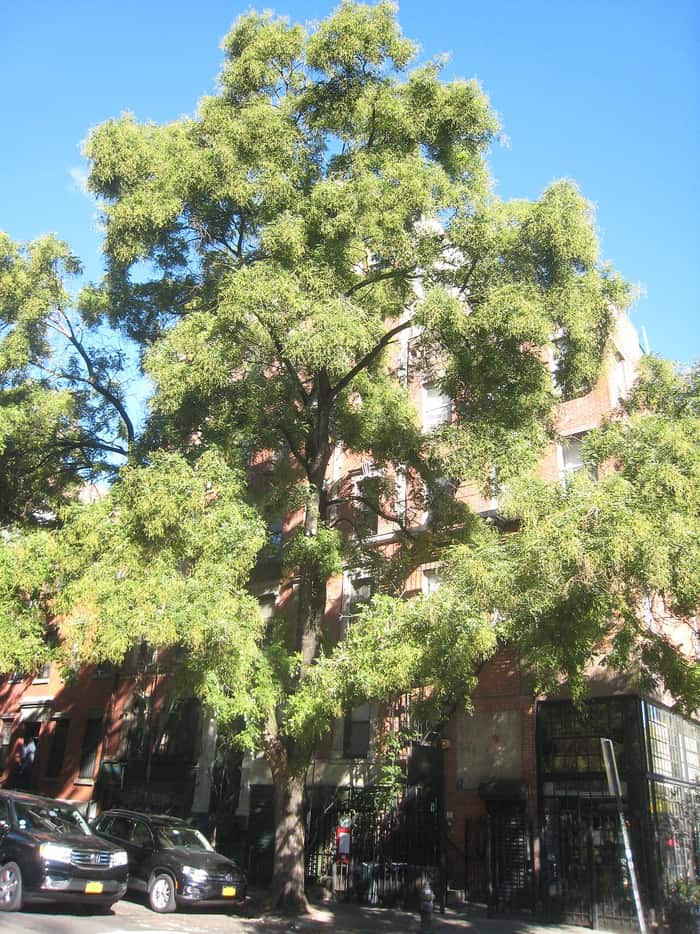
Photos of New York City Marble Cemetery
Questions
Can you visit the New York City Marble Cemetery?
Only on a few days a year. The cemetery’s website says it opens once on a Sunday in spring and on a weekend in the fall, so check the current dates.
Where is the New York City Marble Cemetery?
At 52–74 East 2nd Street, between First and Second Avenues, in the East Village of Manhattan.
How many vaults does the cemetery have?
It has 258 underground burial vaults built of Tuckahoe marble.
Is it the same as the New York Marble Cemetery?
No. The New York Marble Cemetery is a separate cemetery one block to the west and was founded a year earlier, in 1830. This one was founded in 1831.
Who is buried in the New York City Marble Cemetery?
Burials include the mayors Stephen Allen and Isaac Varian, the revolutionary hero Marinus Willett, the financier Moses Taylor and the New York Public Library co-founder James Lenox.
Is the cemetery a New York City landmark?
Yes. It was designated a city landmark in 1969 and added to the National Register of Historic Places in 1980.
Also nearby

New York Marble Cemetery
New York Marble Cemetery · a hidden 1830 graveyard of marble vaults
200 m away
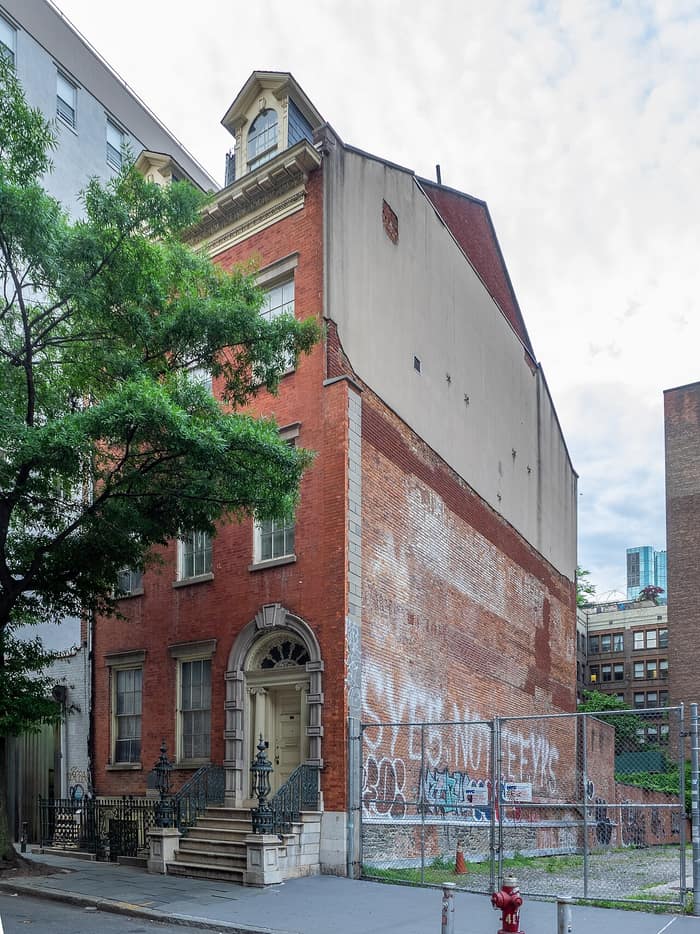
Merchant’s House Museum
Merchant’s House Museum · NoHo home with its original interior
400 m away
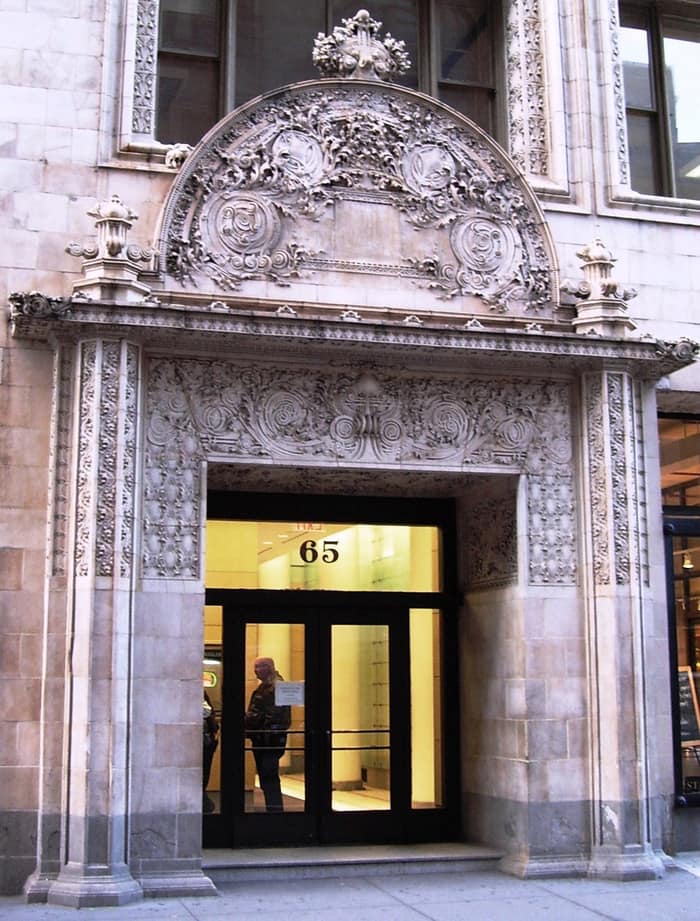
Bayard-Condict Building
Bayard-Condict Building · Sullivan’s only NYC skyscraper, with winged angels
550 m away

St. Mark’s Church in-the-Bowery
St. Mark’s Church · Peter Stuyvesant’s vault and poets’ stage
650 m away