
New York Marble Cemetery, the East Village’s Secret Vaults
The New York Marble Cemetery is a walled burial ground tucked inside a block of the East Village in Manhattan. Opened in 1830, it was the city’s first non-sectarian cemetery, and it still keeps its rows of underground family vaults out of sight from the street. It is a quiet, little-known stop for anyone looking for hidden gems in NYC, although it is open only on limited days.
Behind an alley gate in the East Village lies a lawn with no gravestones at all: 156 marble vaults, built in 1830 as a cure for the city’s fear of yellow fever, sleep right under the grass.
The history of the New York Marble Cemetery
The New York Marble Cemetery was founded in 1830 as a commercial venture of Perkins Nichols, who hired two lawyers, Anthony Dey and George W. Strong, as organizing trustees. The timing matters. Repeated outbreaks of yellow fever had made New Yorkers uneasy about burying their dead in coffins only a few feet below the surface, and public health legislation had outlawed earthen burials. Nichols saw a market for a different kind of grave: a sealed vault set deep underground.
Dey and Strong bought the land on his behalf on July 13, 1830, at what was then the northern edge of residential development. Nichols had 156 underground family vaults built from Tuckahoe marble, each about the size of a small room, and laid them out in a grid of six columns by 26 rows. He recovered his costs by selling the vaults to families. The founders then asked the New York State Legislature for a special act of incorporation, which was granted on February 4, 1831.
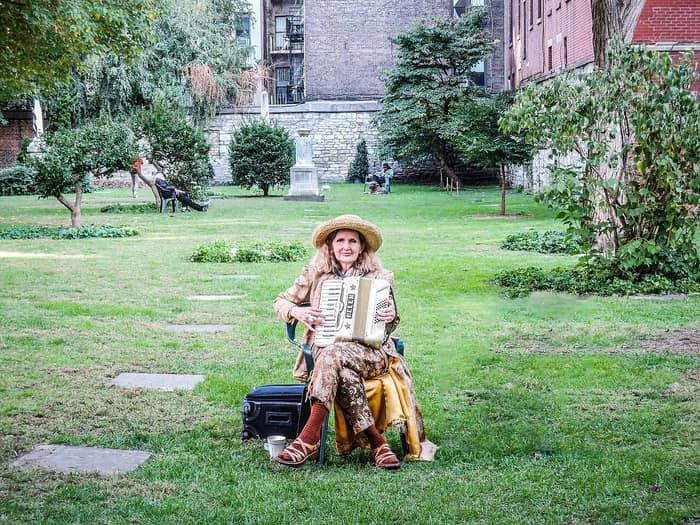
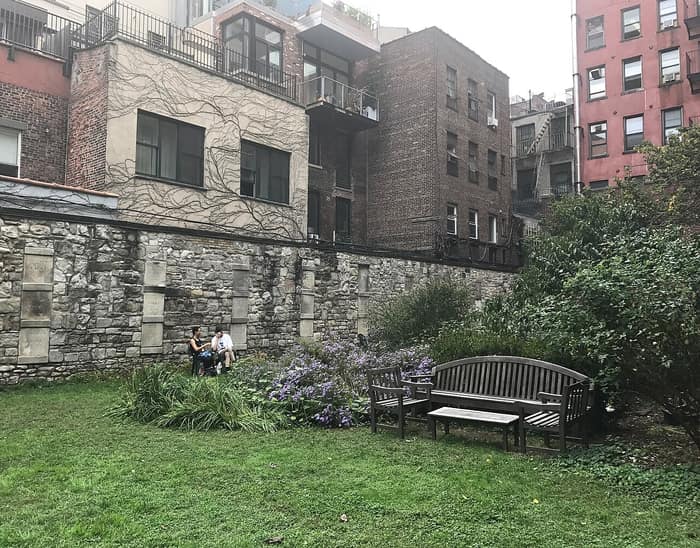
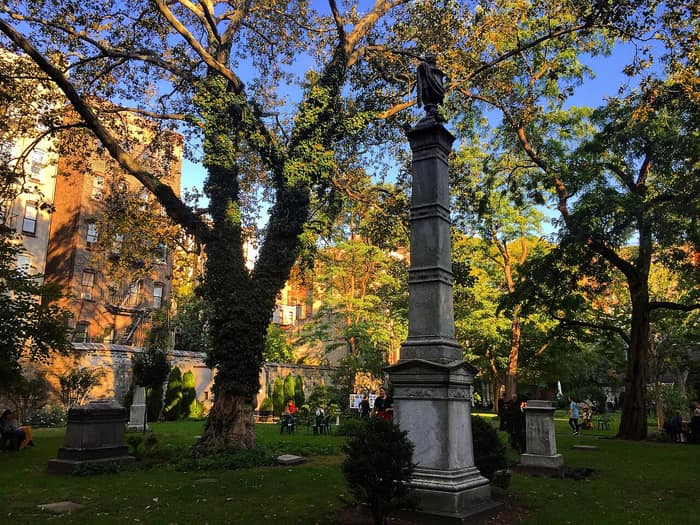
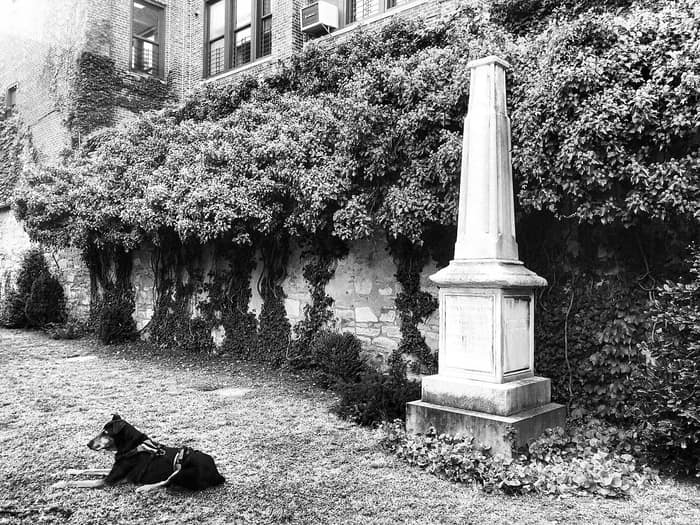
The design is unusual. Above ground there is only a lawn, with no monuments or markers. Each pair of barrel vaults is reached by lifting a stone slab set well below the level of the grass. Marble tablets mounted in the long north and south walls name the original vault owners, but not the people buried inside, and show exactly where each vault lies underground. A plaque on the entrance gate notes that descendants of the 19th-century owners may still be buried here.
About 2,100 burials appear in the cemetery’s written registers, most of them from prominent professional and merchant families of New York. Notable names include the plastic surgeon Gurdon Buck, Aaron Clark, mayor of New York City from 1837 to 1839, the tobacco businessman Pierre Lorillard II, the Erie Canal chief engineer Benjamin Wright, the congressman James Tallmadge Jr. and the art patron Luman Reed. Stevens T. Mason, the first governor of Michigan, was buried here but later reinterred in Detroit. Old New York families such as the Beeckmans, Hones, Hoyts, Quackenbushes, Varicks and Van Zandts also own vaults.
The cemetery is often confused with the New York City Marble Cemetery one block to the east, which is entirely separate and was founded a year later. Both were designated New York City landmarks in 1969 and listed on the National Register of Historic Places in 1980. In recent decades the walls needed care: by 1997 parts of the north wall had collapsed and others needed steel buttresses, and the weakened sections were dismantled and rebuilt to an eight-foot height, with the buttresses removed by November 2018.
Little-known facts about the New York Marble Cemetery
- It was New York City’s first non-sectarian burial place, open to people of any religion.
- The grass has no gravestones: the only names on view are the marble tablets on the walls, and they list vault owners, not the dead.
- Each of the 156 vaults is about the size of a small room and was built from Tuckahoe marble.
- A different cemetery with almost the same name, the New York City Marble Cemetery, stands one block east and was founded a year later.
- Stevens T. Mason, the first governor of Michigan, was first buried here and was later moved to Capitol Park in Detroit.
- A researcher’s book, published in 2020, collects the cemetery’s interments from 1830 to 1937, and related records are held at the New-York Historical Society.
Tours near New York Marble Cemetery
Experiences in the area that you can book online with Viator:


Visiting the New York Marble Cemetery
- The cemetery sits inside a city block and is entered through an alley with an iron gate at each end, between 41 and 43 Second Avenue. From the street it is easy to walk past without noticing it.
- It is not open every day. The cemetery’s website has listed visits on a few weekends in the spring to fall season, so check the current opening hours and access rules before you go.
- Inside you will see a lawn without monuments, the old marble wall tablets and the stone slabs that mark the vault entrances. The vaults themselves are underground and not open to visitors.
- The area around Second Avenue and the Bowery is a good base for a walk through the East Village, and the sources list the Merchant’s House Museum and Bayard-Condict Building among the places nearby.
- It is a burial ground with living descendants, so visit quietly and respectfully.
Opening hours, access and conditions can change. Check before you go.
Map: where New York Marble Cemetery is
Photos of New York Marble Cemetery
Where to stay near New York Marble Cemetery
Hotels close by, with ratings and current availability.

NobleDEN Hotel
Check availability ›
The Marlton Hotel
Check availability ›
Washington Square Hotel by Library Hotel Collection
Check availability ›Hotel photos: Expedia Group. Ratings are shown as published there. Availability and conditions change; check the booking page. Affiliate links: we may earn a commission at no extra cost to you. All hotels by borough
Questions
Can you visit the New York Marble Cemetery?
Yes, but only on limited days. The cemetery is usually open on selected weekends from spring to fall, so check its current schedule and access rules before you plan a visit.
Where is the New York Marble Cemetery?
It is in Manhattan’s East Village, inside the block bounded by 2nd Street, Second Avenue, 3rd Street and the Bowery. The entrance is an alley between 41 and 43 Second Avenue.
How many people are buried in the New York Marble Cemetery?
The written registers record about 2,100 burials, most from prominent professional and merchant families. They lie in 156 underground vaults built from Tuckahoe marble.
Why does the New York Marble Cemetery have no gravestones?
It was designed around underground family vaults, reached by lifting stone slabs below the level of the lawn. Names appear only on marble tablets in the walls, which list the original vault owners.
Is it the same as the New York City Marble Cemetery?
No. The New York City Marble Cemetery is a separate burial ground one block east, founded a year later. Both are city landmarks and are listed on the National Register of Historic Places.
Who is buried in the New York Marble Cemetery?
Among others, the plastic surgeon Gurdon Buck, Mayor Aaron Clark, the tobacco merchant Pierre Lorillard II, the Erie Canal engineer Benjamin Wright and the art patron Luman Reed.
Also nearby
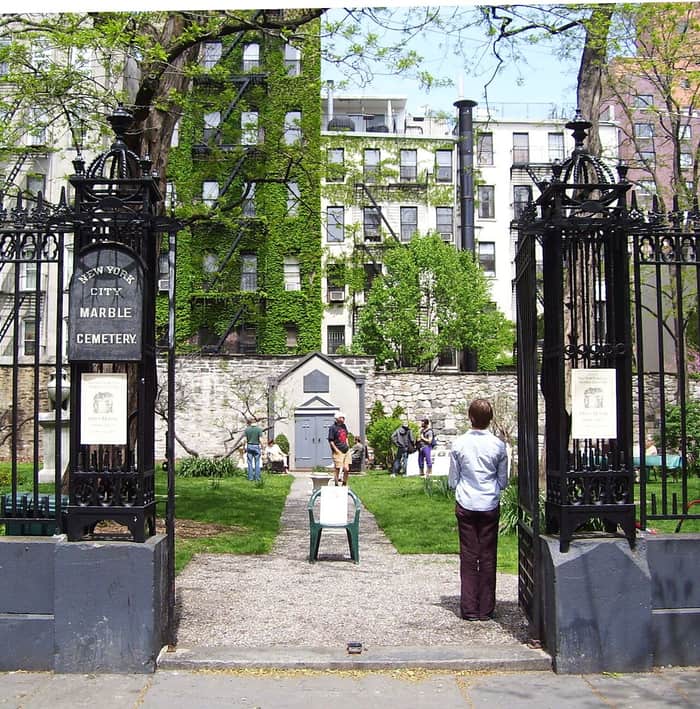
New York City Marble Cemetery
NYC Marble Cemetery · 258 marble vaults behind a wall
200 m away
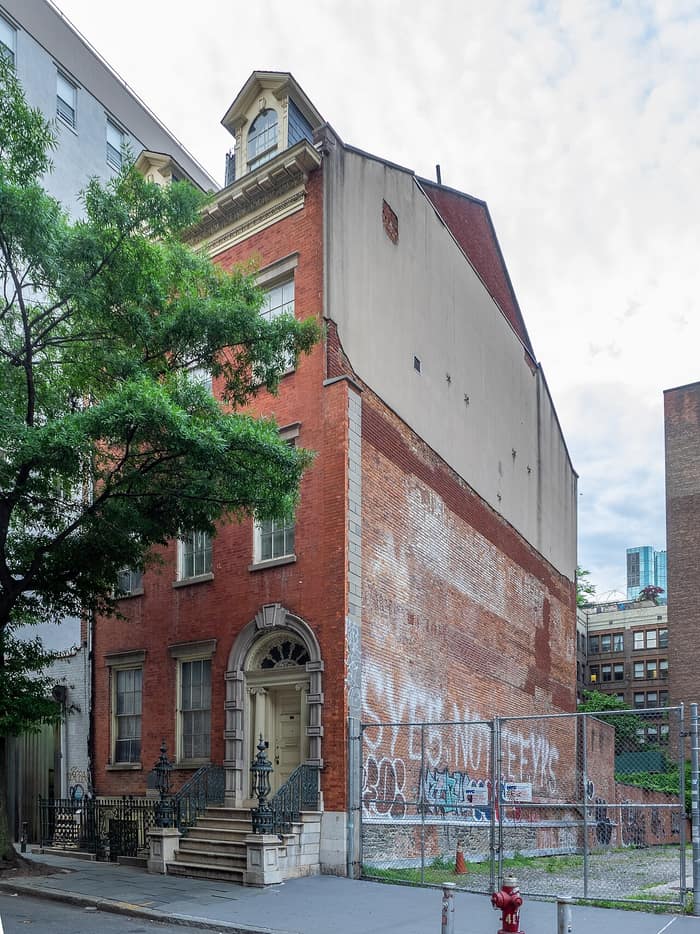
Merchant’s House Museum
Merchant’s House Museum · NoHo home with its original interior
250 m away
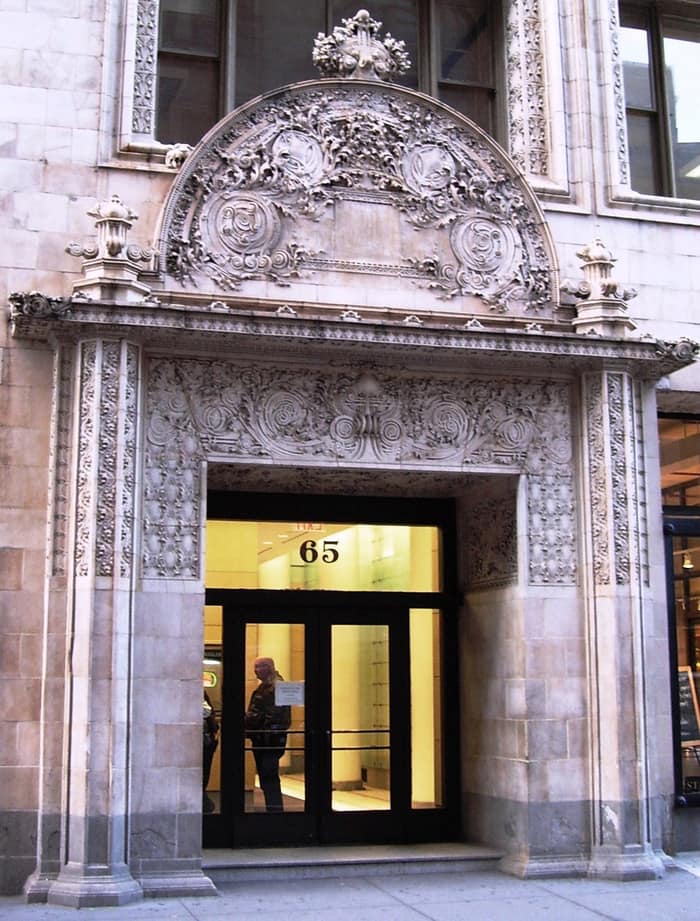
Bayard-Condict Building
Bayard-Condict Building · Sullivan’s only NYC skyscraper, with winged angels
350 m away

St. Mark’s Church in-the-Bowery
St. Mark’s Church · Peter Stuyvesant’s vault and poets’ stage
600 m away